Awareness — Dr. M. Ariff's Educational Notes
Content drawn directly from Dr. Mahfuz Ariff's patient education pamphlets, written to demystify cancer treatment for patients and families in Eastern India.
1. Understanding Cancer & Its Treatment
Cancer is a dreadful disease. In earlier times people used to say "Cancer has no answer" — meaning death from this disease was considered certain. That situation has now fundamentally changed. Over the last three decades, significant research has been done on this disease and continues today.
The Three Main Types of Cancer Treatment
Every cancer patient may need one or more of the following treatment types. Together, this is called Multimodality Treatment:
- Surgery (শল্য চিকিৎসা / সার্জারী) — Surgical removal of the tumour
- Radiation Therapy (বিকিরণ চিকিৎসা / রেডিওথেরাপি) — High-energy ray treatment
- Drug Therapy / Chemotherapy (ওষধি চিকিৎসা / কেমোথেরাপি) — Medicines that destroy cancer cells
How Radiation Works — Dispelling Fear
Many patients fear radiotherapy because of misconceptions — they worry it involves electric shocks, burning heat, or that the body part will be scorched. None of this is true.
In physics, we know about light rays such as visible light. X-rays work similarly — they are electromagnetic rays. When you have an X-ray taken, you feel no pain at all, and the same principle applies to radiation therapy. High-energy rays pass through the body and are targeted precisely at cancer cells. No burning, no electric sensation.
2. Radiotherapy (বিকিরণ চিকিৎসা)
Radiotherapy is one of the most effective treatments for cancer. 60–70% of cancer patients require it at some point in their treatment journey. Understanding its purpose and method removes unnecessary fear.
Types of Radiotherapy by Goal
Radical Radiotherapy
Delivered with curative intent — to completely destroy all cancer cells in a specific area. Given 5 days a week (Monday to Friday), for 5 to 7 weeks. Dose: 5,000 to 7,000 rads.
Palliative Radiotherapy
Given with low doses to reduce suffering, not necessarily to cure. Used for:
- Severe pain (e.g. bone pain)
- Breathing difficulty
- Multiple brain tumours
- Excessive or uncontrolled bleeding
Even when a cure is not possible, palliative radiotherapy meaningfully improves quality of life.
Methods of Delivering Radiation
(a) Teletherapy — External Beam Radiation
The patient lies at a distance from the machine. The machine directs radiation at the tumour from outside the body.
| Machine | Power |
|---|---|
| Cobalt unit | 1.25 million volts |
| Linear Accelerator (LINAC) | 6–20 million volts (adjustable) |
Advanced techniques now available:
- 3DCRT — 3D Conformal Radiation Therapy
- IGRT — Image Guided Radiation Therapy
- IMRT — Intensity Modulated Radiation Therapy
- SRT — Stereotactic Radiation Therapy
(b) Brachytherapy — Internal Radiation
Radioactive material is placed inside or very near the tumour, through tubes, needles, or applicators. This delivers a very high dose directly to the cancer while surrounding tissue receives far less.
- Commonly used for cancers of the uterus, vagina, and cervix
- Can also be applied to the breast, tongue, and mouth
- Materials used: Radium (historically), Caesium, Cobalt, Iridium
Side Effects
Side effects of radiation therapy are generally minor and temporary. Once the radiation course is completed, they resolve on their own.
Dr. M. Ariff has published a patient leaflet on this topic in Bengali & English. Click the cover below to view or download it.

3. Chemotherapy (ওষধি চিকিৎসা / কেমোথেরাপি)
Chemotherapy uses drugs to destroy cancer cells throughout the body. Many cancers are completely cured by chemotherapy — including Choriocarcinoma, Lymphoma, Blood cancers / Leukaemia, and Breast cancer.
When is Chemotherapy Given?
| Timing | Name | Purpose |
|---|---|---|
| Before surgery or radiotherapy | Neoadjuvant | To shrink the tumour first, making other treatments more effective |
| During radiotherapy | Concurrent | Small doses alongside radiation to enhance radiation's effect |
| After surgery or radiotherapy | Adjuvant | To prevent the cancer from returning |
| After the disease has improved | Maintenance | A specified dose to keep the disease from returning |
How Chemotherapy Works
Drugs work at various levels inside cancer cells — interfering with the cytoplasm, nucleus, and cell division processes. Treatment is typically given once a week, once every two weeks, or once every three weeks. Generally 6 cycles over 6 months are given. Multiple drugs are often combined — Combination Drug Therapy.
Performance Scale (ECOG) — Who Can Receive Chemotherapy?
| Score | Meaning |
|---|---|
| 0 | Can do all activities normally |
| 1 | Cannot do strenuous physical exertion |
| 2 | Can manage daily household tasks at home |
| 3 | Can only care for self — eating, bathing — but not normal daily tasks |
| 4 | Completely bedridden, cannot do anything |
How to Measure if Chemotherapy is Working
| Response | Abbreviation | Meaning |
|---|---|---|
| Complete Response | CR | Disease has been completely eradicated |
| Partial Response | PR | Disease has decreased but is still present |
| Stable Disease | SD | Disease has neither increased nor decreased |
| Progressive Disease | PD | Disease is increasing despite treatment |
Side Effects & Their Management
| Side Effect (বাংলা) | Side Effect (English) | Recommended Treatment |
|---|---|---|
| বমি | Vomiting | Tab EMESET 8mg — 1 tab twice daily before food × 5 days |
| চুলকানি | Itching | Tab ALLEGRA 120mg once daily × 6 days; Tab WYSOLONE 10mg once daily after breakfast × 6 days |
| মুখে ঘা হওয়া | Mouth sores | HEXEDINE mouth wash 3× daily × 7 days; Tab CLOGEN 10mg twice daily × 10 days |
| পায়খানা বেশী হওয়া | Diarrhoea | Tab LOMOTIL twice daily × 3 days; Tab OFLOMAC 200mg twice daily × 5 days; LACTOBACILLE Plus Cap twice daily × 5 days; ELECTRAL Water × 3 days |
| কোষ্ঠকাঠিন্য | Constipation | Syr DUPHALAC 2–4 tsp twice at bedtime daily; PRACTOCLYSS ENEMA SOS |
| জ্বর | Fever | Tab CALPOL 500mg SOS up to 3×/day; AZITHRAL 500mg once daily × 6 days |
| পায়ে ব্যথা | Leg/Foot pain | Warm compress with hot water bag once daily; Tab COMBIFLAM twice daily after food × 5 days; VOLINI GEL/SPRAY massage SOS |
| অম্বল বেড়ে যাওয়া | Increased acidity | Cap RABIFAST DSR — 1 cap twice daily before food × 7 days |
| ঘুম কম হওয়া | Insomnia | Tab ALZOLAM 1mg — 1 tab at bedtime |
| চুল পড়া | Hair loss | No medication needed — only reassurance; hair regrows after treatment |
| রক্ত কমে যাওয়া | Low blood count (anaemia) | Tab FERONIAXT — 1 tab once daily |
| শ্বেতকনিকা কমে যাওয়া | Low white blood cells | GCSF 300mcg × 3 days |
| দুর্বলতা | Weakness / Fatigue | Resource Powder 2–4 tsp twice daily with water or milk; BEVON Cap once daily |
| মানসিক ভারসাম্য হারিয়ে ফেলা | Loss of mental balance | NEXITO PLUS Tab — 1 tab at bedtime |
| ক্ষিদে কম হওয়া | Loss of appetite | Syr CYP-L — 1 tsp at bedtime |
Dr. M. Ariff has published a patient leaflet on this topic in Bengali & English. Click the cover below to view or download it.

4. Cervical Cancer (জরায়ু মুখের ক্যানসার)
How Common Is It?
Cervical cancer is the 4th most common cancer among women worldwide. In 2022 alone: 6,60,000 women were diagnosed globally and 3,50,000 women died from it. The number of cases is increasing in India.
Symptoms to Watch For
- White discharge (সাদা স্রাব)
- Irregular bleeding
- Bleeding after sexual intercourse
- Post-menopausal bleeding (ঋতুবন্ধের পর রক্তপাত)
If you notice any of these symptoms, see a doctor immediately.
Cause
HPV (Human Papillomavirus) is recognised as the cause of this cancer in almost all cases.
Screening — Early Detection Saves Lives
| Test | When |
|---|---|
| Cervical Pap Smear Test | For all women — helps detect the disease at an early stage |
| HPV Test | Once at age 35 years, and once at age 45 years |
Survival Rates by Stage
| Stage | 5-Year Survival Rate |
|---|---|
| Stage 1 | 90% |
| Stage 2 | 75% |
| Stage 3 | 58% |
| Stage 4 | 17% |
Treatment
| Stage | Treatment |
|---|---|
| Early (Stage I & II) | Surgery, followed by Radiation Therapy |
| Advanced (Stage III & IV) | Radiation Therapy + Chemotherapy |
Prevention — What to Avoid
- Early marriage and early pregnancy
- Smoking (ধূমপান)
- Malnutrition (অপুষ্টি)
- Unhygienic conditions (অপরিষ্কার থাকা)
- Irresponsible sexual behaviour
Vaccination — The Most Powerful Prevention Tool
This is the first cancer for which a vaccine exists and is highly effective.
| Age Group | Number of Doses |
|---|---|
| 9–14 years | 2 doses |
| 15–26 years | 3 doses |
If vaccinated in this age range, the risk of developing cervical cancer in the future is dramatically reduced.
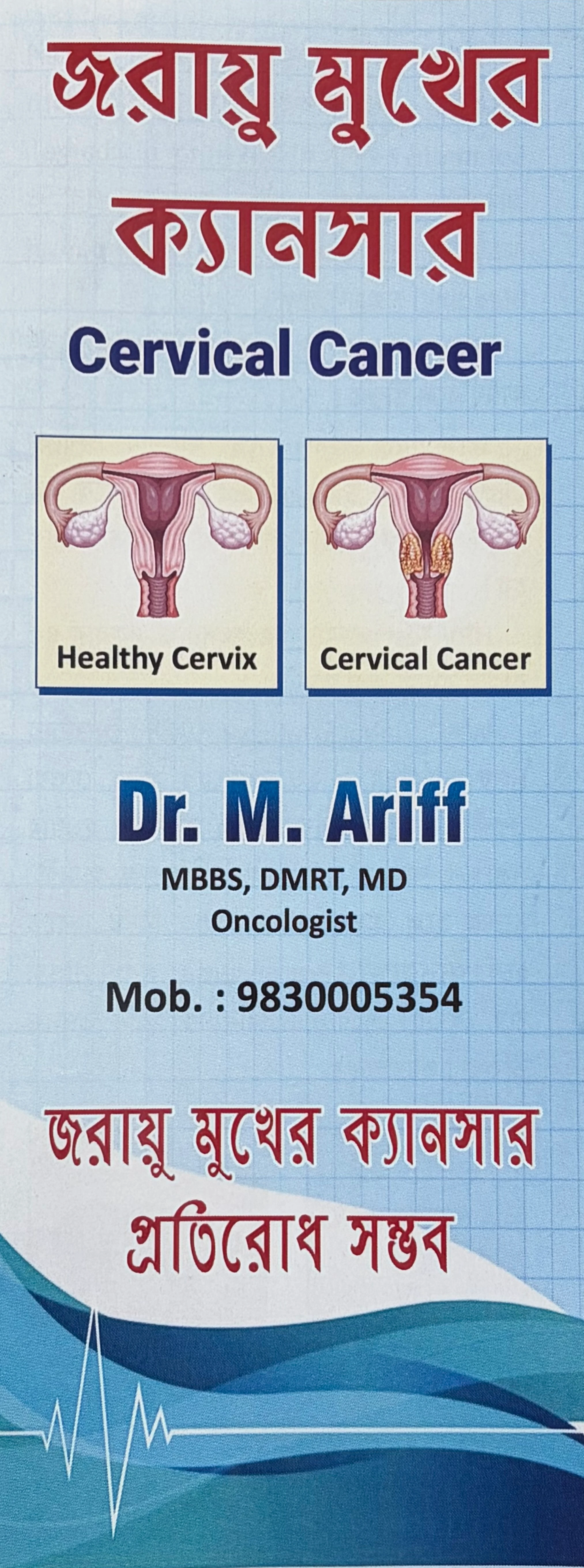
Dr. M. Ariff has published a patient leaflet on this topic in Bengali & English. Click the cover below to view or download it.
5. Colorectal Cancer — Colon & Rectum (বৃহদন্ত্র ও মলাশয়ের ক্যানসার)
Yes! Cancer can be prevented. Current research tells us not just how to treat cancer, but why it occurs, and therefore how to stop it from occurring.
Among all cancers, colorectal cancer is the third most common, accounting for approximately 9% of all cancers. Numbers in India are rising.
Symptoms to Watch For
- Blood in stool (রক্তপড়া)
- Abdominal pain or cramps (ব্যথা যন্ত্রণা)
- Stool getting stuck or bowel obstruction
- Loss of appetite (ক্ষুধামান্দ্য)
- Frequent or irregular bowel movements
Risk Factors
| Risk Factor | Detail |
|---|---|
| খাদ্যাভাস (Diet) | Oily, fatty, and fried foods |
| Red meat consumption | Eating too much red meat |
| ধূমপান (Smoking) | A major contributing factor |
| Low physical activity | Sedentary lifestyle increases risk |
| Family history | Cancer in a close relative |
| Digestive tract conditions | Adenoma, inflammatory conditions |
Diagnosis
| Method | Purpose |
|---|---|
| Stool Occult Blood Test | First-line screening — detects hidden blood in stool |
| Colonoscopy | Visual inspection of the colon |
| Biopsy | Tissue sampling to confirm cancer |
| CT Scan & PET CT Scan | Detailed imaging |
| MRI | Especially important for rectal cancer staging — must be done before deciding treatment |
| Genetic & Molecular Study | Guides targeted treatment decisions |
Treatment
- Primary treatment: Surgery (Operation)
- Additional treatments as needed: Radiation Therapy and/or Chemotherapy
- Modern option: Targeted Drug therapy now gives excellent results for suitable patients
Three Levels of Prevention
(a) Primary Prevention
- Stop smoking
- Reduce fatty food and red meat consumption
(b) Secondary Prevention
- Get a stool test and colonoscopy regularly
- Catch the disease at an early stage before it causes pain — treatment is far simpler at this point
(c) Primordial Prevention
- Add to your diet: Vitamin C, Vitamin E, Calcium, and Fibre-rich foods
- These have been shown to reduce cancer risk
What You Should Do Right Now
- Get a Stool Occult Blood Test — it is simple and non-invasive
- If the result shows a problem — get a colonoscopy
- Change your habits and lifestyle — diet and exercise make a measurable difference
6. Breast Cancer
What Is Breast Cancer?
The body is made up of cells that grow and die in a controlled way. Sometimes cells keep dividing without normal controls, forming an abnormal growth called a tumour.
- If the tumour does not invade nearby tissues — it is called a Benign Tumour
- If it invades and destroys nearby tissue — it is called a Malignant Tumour or Cancer
Cancer that begins in the breast is always called Breast Cancer — even if it later spreads to the liver, bones, or brain.
Risk Factors
- Diet & Obesity
- Genes & Hormones
- Alcohol consumption
- Age
- Environmental causes
Types of Breast Cancer
| Type | Origin | Notes |
|---|---|---|
| Lobular Carcinoma | Glands (lobules) | Originates in milk-producing glands |
| Ductal Carcinoma | Ducts | Originates in milk ducts — most common type |
| Invasive Cancer | Either | Has extended beyond immediate surroundings |
| In-situ Carcinoma | Either | Very limited — has not crossed its boundary |
| Inflammatory Breast Cancer | Either | Aggressive; often has no lump — detected by nipple/skin changes |
Signs & Symptoms
- A lump that can be felt in the breast
- Skin dimpling
- Change in skin colour or texture
- Skin becoming coarse and wrinkled ("orange skin" appearance)
- Discharge from the nipple
- Change in how the nipple looks
Screening & Diagnosis
| Method | Details |
|---|---|
| Self-examination | Monthly self-check recommended for all women |
| Mammography | Reduces breast cancer mortality by 20–30%; annual mammograms encouraged for women over 40 |
| MRI | Used for women with family history, oncogene mutations, or breast implants |
| Ultrasound | Useful for characterising palpable lumps and guiding biopsies |
| Fine Needle Aspiration / Core Needle Biopsy | To obtain tissue for histological examination |
| HER2 Testing | Tests for HER2 protein (guides targeted therapy decisions) |
| Bone scan, CT, PET scan | To detect if cancer has spread |
Staging
| Stage | Description |
|---|---|
| Stage 0 | Carcinoma in-situ — non-invasive |
| Stage I | Tumour ≤ 2 cm, no lymph node involvement |
| Stage IIA | Tumour 2–5 cm, nodes negative; or > 2 cm with nodes positive |
| Stage IIB | Tumour > 5 cm, nodes negative; or 2–5 cm with < 4 nodes |
| Stage IIIA | Tumour > 5 cm with positive nodes, or 2–5 cm with 4+ axillary nodes |
| Stage IIIB | Tumour has penetrated chest wall or skin |
| Stage IIIC | Spread to 10+ axillary nodes or supra/infraclavicular nodes |
| Stage IV | Distant metastasis to other organs |
Treatment
Surgery
- Lumpectomy — Removal of only the lump and surrounding breast tissue; breast is preserved
- Mastectomy — Removal of the entire breast; preferred in certain cases
- Lymph nodes under the arm are also examined and may be removed (Sentinel Lymph Node dissection)
Radiation Therapy
Given after surgery as an essential part of breast-conserving treatment. Given 5 days a week over 5–7 weeks. Each session takes approximately 15 minutes. Healthy tissue has time to repair between sessions.
Chemotherapy Regimens
| Regimen | Drugs |
|---|---|
| CMF | Cyclophosphamide + Methotrexate + 5-Fluorouracil |
| FAC | 5-Fluorouracil + Doxorubicin + Cyclophosphamide |
| AC | Doxorubicin + Cyclophosphamide |
| AC-T | AC followed by Paclitaxel |
| TAC | Docetaxel + Doxorubicin + Cyclophosphamide |
| FEC-T | FEC × 3 cycles, then Docetaxel × 3 cycles |
| Dose-dense AC | AC given every 2 weeks (instead of 3) followed by Paclitaxel |
| TC | Docetaxel + Cyclophosphamide |
Hormonal Treatment
For patients with oestrogen receptor positive (ER+) tumours:
- Tamoxifen — for premenopausal women; blocks oestrogen receptors
- Aromatase Inhibitors (Letrozole, Anastrazole) — for postmenopausal women; lowers oestrogen levels
- GnRH analogues / Ovarian Ablation — additional options for premenopausal women
Targeted Therapy
For patients whose cancer over-expresses the HER2 protein:
- Trastuzumab (Herceptin) — blocks the HER2 protein, slowing cancer cell growth
Breast Cancer & Bone Metastasis
Breast cancer can spread (metastasise) beyond the breast via blood vessels and lymphatics. 70% of the time when breast cancer spreads to other locations, it spreads to bone — especially the vertebrae and long bones of the arms, legs, and ribs.
- It is treatable for many years but generally not curable at this stage
- Bones become weak and fracture easily — causing pain, the need for braces, or wheelchair use
- Treatment involves medicines that lower oestrogen levels
Medical Disclaimer
This information is for educational purposes only and should not replace professional medical advice. Always consult a qualified oncologist for diagnosis, treatment decisions, and personalised medical guidance.